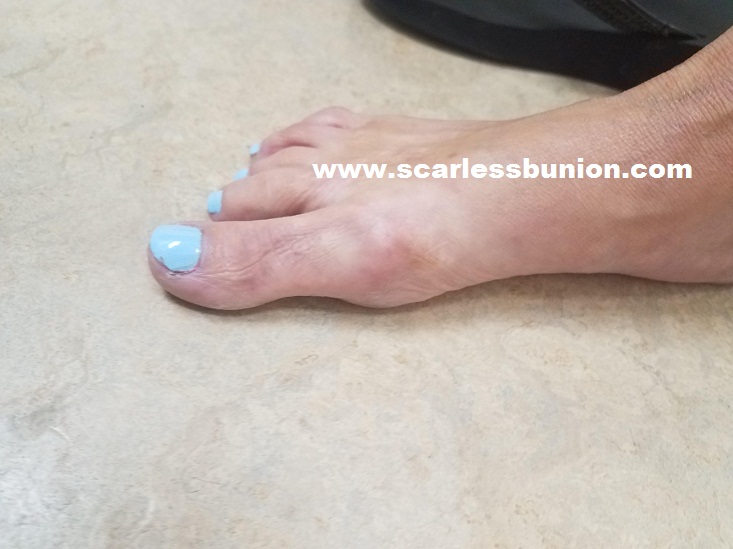
When it comes to addressing bunions, many patients face a tough decision: stick with traditional surgical methods or opt for modern, minimally invasive techniques. Dr. Kevin Lam, a leading podiatric surgeon, has seen firsthand the stark differences between these approaches. A recent case highlights why minimally invasive bunionectomy is becoming the gold standard for lasting results and patient satisfaction.
Traditional (LEFT) vs Minimally Invasive Bunion Surgery (RIGHT)
A Tale of Two Procedures: Traditional vs. Minimally Invasive
A patient returned to Dr. Lam’s office with a concerning issue. On one foot, she had previously undergone a traditional bunionectomy at another facility. Unfortunately, despite the surgery, the bunion returned within just 10 months, leaving her frustrated and in pain. In contrast, her other foot had been treated by Dr. Kevin Lam in 2018 using minimally invasive bunionectomy techniques (Lam bunionectomy). Remarkably, after six years, that bunion had not returned, and the results remained stable.
The Problem with Traditional Bunionectomy
Traditional bunionectomy typically involves larger incisions and more invasive methods to correct the deformity. While this approach can initially seem effective, it often leads to complications, including:
- Higher risk of regrowth: As demonstrated in this patient’s case, the bunion on the traditionally treated foot returned in less than a year.
- More noticeable scarring: Traditional methods leave larger scars, which can affect both aesthetics and confidence.
- Longer recovery times: The extensive nature of the surgery can delay a patient’s return to normal activities.
The Benefits of Minimally Invasive Bunionectomy
Dr. Lam’s minimally invasive approach offers a host of advantages that directly address the shortcomings of traditional methods:
- Smaller incisions, minimal scarring: The procedure leaves virtually no visible scars, enhancing the cosmetic outcome.
- Reduced risk of regrowth: As seen in the patient’s six-year follow-up, the results of minimally invasive bunionectomy are more durable.
- Faster recovery: Patients typically experience less pain and can return to their daily lives much sooner.
Turning Back the Clock
In the patient’s case, Dr. Lam plans to perform a minimally invasive bunionectomy on the traditionally treated foot to correct the recurrence and provide a long-lasting solution. This “turning back the hands of time” approach showcases the adaptability and effectiveness of minimally invasive techniques, even in cases where previous surgeries have failed.
Why Choose Minimally Invasive?
Patients who choose minimally invasive bunionectomy not only benefit from better aesthetics but also gain peace of mind knowing their results are built to last. Dr. Lam’s innovative methods prioritize patient comfort, long-term satisfaction, and overall foot health.
If you’re considering bunion surgery or have experienced complications from a previous procedure, it’s time to explore the minimally invasive difference. Contact Dr. Kevin Lam's office at (239) 430-3668 (FOOT) to take your first step toward a pain-free, confident future.
Bunions are more than just an unsightly bump on the side of your foot. They can cause persistent pain, limit your mobility, and make everyday activities uncomfortable. If you’re tired of living with foot discomfort, it’s time to take control of your health and explore options to get your bunion fixed.
What Is a Bunion?
A bunion, medically known as hallux valgus, is a bony protrusion that forms at the joint where your big toe meets the foot. It occurs when the big toe starts leaning towards the second toe, creating a misalignment. Common symptoms include:
Pain or tenderness in the joint.
Redness or swelling around the affected area.
Difficulty finding comfortable shoes.
Reduced range of motion in the toe.
Why Should You Fix Your Bunion?
Ignoring a bunion won’t make it go away—it will likely worsen over time. Here’s why seeking treatment is important:
Relieve Pain: Stop the persistent ache that affects your quality of life.
Restore Mobility: Enjoy walking, running, or exercising without limitations.
Prevent Complications: Avoid secondary issues like hammertoes, calluses, or arthritis.
Boost Confidence: Wear the shoes you love without discomfort or embarrassment.
Minimally Invasive Bunion Surgery
For severe or persistent bunions, surgery is often the best option. Procedures like the Lapiplasty® 3D Bunion Correction or MIS (Minimally Invasive Surgery) offer quicker recovery times and lasting results. These techniques not only address the cosmetic appearance but also correct the structural misalignment for long-term relief.
What to Expect During Recovery
Post-surgery recovery has come a long way. Depending on the procedure, you may be able to bear weight on your foot within days and return to normal activities in a few weeks. Following your surgeon’s instructions and attending follow-up appointments are crucial for optimal healing.
Ready to Take the First Step?
Don’t let a bunion hold you back from living a full, active life. At Family Foot & Leg Center, we specialize in cutting-edge treatments designed to get you back on your feet—pain-free and confident. Whether you’re just starting to experience symptoms or have been struggling for years, our team is here to guide you through every step of the journey.
Schedule your consultation today and discover the life-changing benefits of bunion correction! If you are experiencing foot problems, don’t delay. Contact Family Foot & Leg Center office at (239) 430-3668 (FOOT) or visit www.scarlessbunion.com to schedule an examination.
Serving Southwest Florida Since 2005, Family Foot & Leg Center has 9 convenient locations throughout Collier, Lee, Charlotte, and Sarasota Counties. Offering pediatric to geriatric family care: Ingrown Toenails, Heel Pain, Bunions, Foot / Ankle Arthritis Pain, Plantar Fasciitis, Foot / Ankle Surgery, Custom Orthotics, and Diabetic Wound Care. In office X-rays, ultrasounds, and minor surgical suite exam rooms. Practice powered by EMR and advanced technologies. Home of the Lam Minimally Invasive No-Scar Bunion Surgery! Come Discover Why Patients Love Our 5-Star Foot & Ankle Care! Same Day Appointments! Easy Online Appointment Scheduling.
Bunions can be painful, unsightly, and a source of discomfort for many people. The good news is that advancements in foot surgery, like minimally invasive bunionectomy, offer a more efficient and less invasive solution for those suffering from this condition. Dr. Kevin Lam is proud to provide this cutting-edge procedure to help patients regain their mobility and comfort with minimal downtime.
The Patient’s Journey
In a recent case, a patient returned to Dr. Lam’s office for her second minimally invasive bunionectomy, after achieving impressive results with her first surgery. The initial procedure had successfully corrected a severe bunion on one foot, leaving her with just a small scar and, most importantly, significant relief from the discomfort that once plagued her daily life. Now, she’s back to address the other foot and get the same excellent results.
Dr. Lam’s minimally invasive technique involves making a tiny incision to remove the bunion and correct the deformity. Unlike traditional bunion surgeries, which often require large incisions and longer recovery times, this approach allows for quicker healing and reduced scarring. After just three months, the patient had virtually no visible signs of the surgery, only a small scar, and was thrilled with her improved foot health.
What Makes Minimally Invasive Bunionectomy Different?
Traditional bunion surgery can be a daunting prospect for many patients due to the potential for extended recovery periods, noticeable scars, and discomfort during the healing process. However, minimally invasive bunionectomy, as performed by Dr. Lam, offers significant benefits, including:
- Smaller Incisions: The minimally invasive technique uses much smaller incisions, reducing scarring and speeding up the healing process.
- Quicker Recovery: Patients can typically resume normal activities much faster than with traditional surgeries.
- Less Pain: With less tissue disruption, patients often experience less post-surgical pain.
- Impressive Results: As seen in this case, the correction is effective, leaving patients with improved foot alignment and comfort.
Dr. Kevin Lam is a highly experienced podiatric surgeon specializing in minimally invasive techniques that help patients return to their daily routines as quickly as possible. He understands that bunions can affect more than just your feet—they can limit your overall mobility and impact your quality of life. That’s why he focuses on providing solutions that not only correct the problem but also minimize discomfort and scarring.
If you’re struggling with bunions and want to explore the option of minimally invasive surgery, Dr. Lam and his team are ready to help. Contact us today to learn more about how you can achieve long-lasting relief from bunion pain and get back to living your life to the fullest.
Bunion surgery doesn’t have to be a major ordeal. Thanks to Dr. Kevin Lam’s minimally invasive approach, you can enjoy quicker recovery times, less scarring, and outstanding results. Whether you’re dealing with a small bump or a severe bunion, this advanced technique offers an effective solution with minimal disruption to your life.
Don't let bunion pain slow you down—schedule a consultation with Dr. Kevin Lam today and take the first step toward healthier, happier feet!
Bunions can be a painful and frustrating problem, often causing discomfort and limiting mobility. Traditionally, bunion surgery has been associated with large incisions, significant recovery time, and permanent screws or wires left inside the foot. However, Dr. Kevin Lam and his team at the Family Foot & Leg Center have developed an advanced, minimally invasive approach to bunionectomy that delivers impressive results with less downtime.
Recently, a patient returned for a six-month follow-up after undergoing this minimally invasive bunionectomy. She was so pleased with the outcome on her first foot that she requested the same procedure for her other foot. Let's take a closer look at what makes this surgery so effective and why patients are experiencing such positive results.
What Makes It Minimally Invasive?
One of the standout features of this bunionectomy is the small incision used. Unlike traditional bunion surgery, which often requires a large incision on the top of the foot, Dr. Lam’s minimally invasive technique involves a small cut on the side of the foot. This minimizes scarring and reduces recovery time, making it a more patient-friendly option.
Another key difference is the use of temporary wires instead of permanent screws or implants. In traditional bunion surgery, screws are often left in the foot to hold the bones in place during healing. In this procedure, the wires are removed in the office once healing has progressed, leaving nothing behind inside the foot.
Impressive Healing Results
At the six-month follow-up, Dr. Lam was able to show excellent bone healing, with strong callus formation around the treated area. The bones had shifted significantly to correct the bunion, a necessary move for proper alignment. This shift may seem dramatic, but it is exactly what is needed to achieve optimal results, and the healing process demonstrated the procedure's effectiveness.
Dr. Lam also addressed a common concern among his patients. Some people may consult other doctors unfamiliar with this technique, leading to worry about whether the significant bone shift will heal properly. As the follow-up with this patient showed, the minimally invasive bunionectomy produces excellent healing and strong results even with a significant bone shift.
Faster Recovery and Lasting Results
One of the greatest advantages of this minimally invasive approach is how quickly it can deliver results. The technique allows for high intrametatarsal angles to be corrected without the need for more invasive procedures, such as osteotomy at the base of the bone or fusion surgeries like lapidus or lapiplasty. This patient not only had her bunion corrected, but a tailor’s bunion on the other side of her foot was also fixed without complication.
This cutting-edge approach has proven to be both efficient and highly effective, making it a great option for patients looking for a faster, less invasive way to correct bunions. The results speak for themselves, with many patients, like this one, seeing such success they return for the same procedure on their other foot.
Why Choose a Minimally Invasive Bunionectomy?
If you're dealing with the pain and discomfort of bunions and want a less invasive option for correction, this procedure might be ideal for you. The benefits include:
- Smaller incisions: Less scarring and quicker recovery time.
- Temporary wires: No permanent screws or implants are left in the foot.
- Faster healing: Excellent bone healing and quicker return to activity.
- Lasting results: Significant corrections can be made without more invasive surgeries.
At the Family Foot & Leg Center, Dr. Kevin Lam and his team are dedicated to using the latest techniques to provide their patients with the best outcomes. If you’re considering bunion surgery, schedule a consultation today to find out if a minimally invasive bunionectomy is right for you.
This advanced technique is transforming the way bunions are treated, giving patients a quicker, more comfortable recovery and long-term results they can be proud of. If you're tired of dealing with bunion pain, this minimally invasive procedure may be just what you need.
Range of motion is good, patient is active, and able to go back to her activities.
Minimally invasive surgery gives you the benefit of virtually no scars, no joint stiffness, hardly any pain, and recovery is relatively easy.
Minimally invasive Bunion Surgery
http://www.scarlessbunion.com/
---
We are doing follow-up. Almost a year from the bunionectomies? Not even? We did both feet.
"Yes."
We did the right foot and then we did the left foot. We did the bunion on this side as well as the bunionette on this side. Bunionette on the 5th. So we did a Peabody, reverse Peabody, minimally invasively, you see the scar is beautiful and then we see the scar over here, hardly any, this was from a recent injection. Excuse that.
So, range of motion is good, patient is active, able to go back to her activity. Incision is right here,
pin site is right here. As you can see there's no other bunions, Before she had a splay foot.
So this splayed out. That's what before it looks like, it a splay foot so that's why we did the bunionectomy and the reverse bunionectomy.
The minimally invasive gives you the benefit of no scars -- virtually no scars, no joint stiffness, and hardly any pain, recovery is relatively easy, am I correct?
"Yes."
Good, good, relatively.
"Yes."
It's still surgery.
"Yeah, it's all good."
But overall it looks good, are you happy with it?
"Yes."
Awesome.
Great results, awesome, less than a year for the other one, we're doing great. Back to work.
Bunion Surgery Follow-Up: A Journey to Improved Foot Health:
Left Foot: Five Years Later
Five years after undergoing bunion surgery on their left foot, our patient has experienced significant improvements in comfort and mobility. Before the surgery, they endured chronic pain and discomfort caused by the bunion deformity, affecting their daily activities and quality of life. However, post-operation, they've enjoyed a remarkable reduction in pain and swelling, allowing them to walk and stand with ease.
The minimally invasive bunion surgery performed at Family Foot & Leg Center has not only corrected the bunion deformity but also minimized scarring and accelerated the recovery process. Our patient is thrilled with the long-term results, as they continue to enjoy an active lifestyle without the limitations imposed by their previous foot condition.
Right Foot: Few Months Later
On the other foot, quite literally, our patient underwent bunion surgery just a few months ago, and the results are already promising. By opting for minimally invasive bunion surgery, they've experienced minimal discomfort and downtime, allowing for a smoother recovery compared to traditional surgical methods.
Already, our patient has noticed a significant improvement in the alignment of their right foot, as the bunion deformity is gradually corrected. With the guidance and support of the experienced team at Family Foot & Leg Center, they're confident that their right foot will soon mirror the success of their left foot, leading to enhanced foot health and overall well-being.
Minimally Invasive Bunion Surgery:
At Family Foot & Leg Center, we specialize in minimally invasive bunion surgery, offering patients a revolutionary approach to correcting bunions with fewer complications and faster recovery times. Our innovative techniques prioritize precision and effectiveness, ensuring optimal outcomes for every patient.
If you're considering bunion surgery or seeking follow-up care after a previous procedure, we invite you to explore the benefits of minimally invasive bunion surgery at Family Foot & Leg Center. Our compassionate team is dedicated to providing personalized care and comprehensive support throughout your journey to improved foot health.
Bunion surgery can be a life-changing experience, providing relief from pain and discomfort while restoring mobility and confidence. Through the remarkable journey of our patient, we've witnessed the transformative impact of minimally invasive bunion surgery on foot health and overall well-being.
Whether you're five years post-operation or just a few months into recovery, Family Foot & Leg Center is here to support you every step of the way. Join us in embracing a future of pain-free living and enhanced foot health with minimally invasive bunion surgery.
Are you suffering from the agony of bunions, contemplating surgery, but deterred by the thought of scars and lengthy recovery times? If so, then this might just be the game-changer you've been waiting for.
Bunions, those painful bony bumps that develop at the base of the big toe, can wreak havoc on your mobility and quality of life. For many, the traditional approach to correcting bunions involves invasive surgery, leaving behind noticeable scars and requiring extensive recovery periods. However, there's a revolutionary alternative that's transforming the landscape of bunion treatment: Scarless, Minimally Invasive Bunion Surgery.
Imagine undergoing bunion surgery without the fear of visible scars, minimal recovery time, and virtually no pain. Sounds too good to be true? Well, thanks to advancements in medical technology and innovative techniques pioneered by professionals like Dr. Kevin Lam, the Lam Bunionectomy or Scarless Bunionectomy is now a reality.
Dr. Kevin Lam has not only refined the traditional bunion surgery technique but has also taken it a step further by developing a minimally invasive approach that can be performed right in the comfort and safety of an office surgical suite. This groundbreaking method not only offers the benefit of minimal scarring but also ensures a quicker healing process with significantly reduced risk of complications.
Here's why No Scar Bunion Surgery is gaining traction and why you shouldn't consider any other option without exploring this innovative approach:
1. Minimal Recovery Time:
Traditional bunion surgery often involves weeks or even months of recovery time, during which patients may experience discomfort and limitations in their daily activities. However, with Scarless Bunion Surgery, the recovery time is significantly shortened, allowing patients to return to their normal routines much sooner.
2. Virtually Painless: One of the biggest concerns for individuals considering bunion surgery is the fear of pain during and after the procedure. With the minimally invasive approach used in Scarless Bunion Surgery, patients experience minimal discomfort both during the surgery and throughout the recovery process.
3. No Visible Scars: Unlike traditional bunion surgery, which often leaves noticeable scars, Scarless Bunion Surgery leaves behind minimal to no visible scarring. This is particularly appealing for individuals who are conscious about their appearance and wish to avoid the tell-tale signs of surgery.
4. Office-Based Procedure: Scarless Bunion Surgery can be performed right in the office surgical suite, eliminating the need for hospitalization and providing added convenience for patients. This not only reduces the overall cost of the procedure but also ensures a comfortable and familiar environment for patients undergoing treatment.
5. Reduced Risk of Complications: Dr. Kevin Lam's modified technique for Scarless Bunion Surgery has demonstrated a remarkable track record with no post-operative infections related to the procedure to date. This speaks volumes about the safety and effectiveness of this innovative approach. Patients undergoing surgery in office clinics may benefit from a lower risk of post-operative infections, contributing to better overall outcomes and faster recovery.
So if you're considering bunion surgery, don't make a decision without exploring the option of Scarless Bunion Surgery. With its minimal recovery time, virtually painless experience, and no visible scars, it represents a paradigm shift in the field of bunion treatment. Consult with a qualified healthcare professional, such as Dr. Kevin Lam, to learn more about this groundbreaking technique and how it can help you put an end to the misery of bunions once and for all. Say goodbye to pain, scars, and lengthy recovery times – and hello to a future of improved mobility and comfort.
---
Video transcription:
This foot -- minimally invasive surgery at about three months ago we did this foot again, we did the whole forefoot pretty much, this one left we did it -- as you can see the marking for the Weil osteotomy, the bunionectomy, this one still has the pin and we're a little bit about two months -- a little more, plus or minus two months.
"It's two months".
Two months exactly. Okay thank you for correcting [patient laughs] but that looks great, that looks awesome, just a couple weeks behind, she's a brave one to do both feet at the same time but now you have two regular-looking feet. What do you think?
"Happy, happy, Very happy."
Well that's the incision right there and this is the incision right here two months and three months out, going back in sneakers, a little bit more recovery on this one but we're gonna pull the pin today so let's go. Both bunionectomies were done. Where's the scar -- there are none, right there. Both feet have been done. Looking good, looking good. there's the scar there's the scar, it's really not much, we're doing a follow-up today, the lady came from Orlando, home of Mickey Mouse. Looks really good there, awesome.
---
This was the previous patient, this is the post-op x-ray today. How long ago since the surgery dear?
"Oh, this was July -- one June, one July."
One June, one July, we are in October. Looking good, everything looks good, hardly any pain, her -- as you can see, she's doing very, very well. This is the beauty of the minimally invasive surgery, we did Weil osteotomy number 2, 3, 4, and 5; did hammer toe correction number 2, 3, 4 right here and 5 you see the incision is quite small right here, small incision, a small incision hidden right there, small incision hidden right in there, we have 2, 3, 4, 5 metatarsal, so we're able to cut the bones through the skin with the aid intraoperative fluoroscopy and you said your husband said your toes are what again?
[Patient laughs] "Look the best they have in years".
Beautiful, well I'm glad you like it, it's going to continue healing and you're going to do great dear.
"Great".
This is 11 weeks, we have the Peabody -- reverse Peabody bunionectomy and then we had second metatarsal Weil osteotomy, so we -- she had a lot of pins on met 2 so we did a plantar surgery of the first ray metatarsal head, there's your scar and then here's your scar for the tailor's, here's your scar for the Weil osteotomy where we cut the second metatarsal in order to realign the joint so far it looks really good, it's 11 weeks, back to golf, back to your activity. I think you're going to continue to get better
"Okay".
It's awesome.
Dr. Lam just taking a little break in between my day had an awesome visit with one of my patients, she's 3 years out of the minimally invasive bunionectomy, a very young active female. And as you could hear from her own story
I didn't think she would wear high heels again or dance or etc. I set her expectations straight, she came to me with some arthritis in the big toe joint as well as the second toe joint as you can see on the x-ray you'll see two screws in there because I had to go ahead and fix that second toe joint too because it was dislocated, hammertoe etc.
So she comes in three years later her complaint is 4th and 5th toe pain and contracture we didn't quite address those the last time because that wasn't bothering her, so the things we did address is the bunion, the hammer toe, the dislocated joint, she was in pretty bad shape, she could not walk, could not run and I'll be realistic, you know, can't promise the world when you come in with already arthritis in those joints already, so we took a risk, I told her that likely she won't be able to run or wear high heels. Anyway I'll make her look better but 3 years later she's as happy can be, referred to me a lot of patients for the minimally invasive bunionectomy you'll see on the x-ray, you'll see the results what it looks like 3 years after surgery, the healing is awesome.
Patient does not feel any pain when we did the surgery, she has fourth and fifth toe hammertoe, it happens, they are live tendons moving around in there so we just have to fix that, considering the circumstances she is very happy, she actually exceeded expectations where she can actually go and dance and run and cycle and stay active, she's a very active young lady and you know, it brings me joy to see these patients come back three years, four years, five years out of their Lam bunionectomy and you know that their life has changed, it's a big life-changing experience sometimes with these bunionectomies you never would think she referred a friend and neighbor to me, we're going to fix her soon but you know, there's really no need to wait to get the bunionectomy nowadays, believe it or not over the last -- I would say a few months, right now I've been starting to use the uh minimally invasive Arthrex burr, we started using it, utilizing a saw as it's described, a power saw, I really didn't like that so I went ahead and went away from the power saw because it could generate heat and damage to tissues so went away from that, I went back to the old osteotome which is a chisel and a hammer, the reason why we did that was because to limit the amount of heat to limit the amount of soft tissue damage and that worked really well, that's what this lady had but now within the last few months last half of the year, I would say 2018, Arthrex came out with this soft tissue burr that does not cut -- I mean not soft tissue bone burr that does not cut soft tissue so it's the opposite of what's just said it does not cut soft tissue so which is great it can -- we could go ahead and cut bone and selectively cut bone and not cut tendon, nerve, and vital structures and makes the minimally invasive bunionectomy more minimally invasive, believe it or not, it's just a one stitch, one stab incision, it's not even an incision at all; not even -- it used to be three to six millimeters incision now it's a stab, a stab wound, that's all it is, to get the burr in there and make the cut
The cut is faster and more accurate. And I'm very excited about this guys it's a great advancement in bunion surgery a lot of times patients ask -- I even get calls from other doctors, physicians asking what makes your bunionectomy so different?
Well if you read my website, the bunionectomy is different, we use the minimally invasive method a few of us do it in the United States, it's an adaptation for an older procedure but you know, sometimes the classic is better we don't do a lot of soft tissue damage that's why it's minimally invasive. Our patients do really well with that; proof is in the pudding, follow the next part of this video, subscribe to me on YouTube, you can find me on Instagram, Dr. Kevin Lam, the proof is in the picture and the pudding and the patient testimonials. This is a great way of getting a bunionectomy done, 99% of my bunionectomies are done this way nowadays, there are other reasons why I wouldn't do it but majority of my patients do get it, it's catching a wave that Arthrex, a big orthopedic company as well as Wright Medical has been promoting such minimally invasive surgery, it is catching but not a lot of people understand it yet, not a lot of people in my profession understand or the orthopedic or podiatric community really understand this procedure, you really have to see it to believe it but I've been doing it for years and patients love it, 99% of my patients go through this bunionectomy. Again check it out, go ahead subscribe to my channel you'll see a lot more of these videos with patient testimonials involved, okay thank you
Minimally invasive bunionectomy, three years out, how are you liking it?
"I love it".
Yeah well thanks for referring your friend I almost forgot .
"Oh gosh, yes. I can wear high heels and you said i wasn't going to be able to for a while, and i wear the highest heels ever"
[laughter]
Well good, we have your alignment in place, there's no bump on the side ,the bump is gone, it's sort of like that, resorbed a lot and there's really no scar
"No scar at all and I was back running. Within a few -- I'd say a month and a half"
Beautiful. Now your back, we'll fix the other two toes, number four and five those are hammer toes but not a big deal, we'll get you taken care of, okay?
Bunion surgery, or bunionectomy, has long been associated with discomfort, lengthy recovery periods, and visible scars. However, advancements in medical technology have paved the way for a revolutionary approach – minimally invasive bunion surgery. Let us look into the ins and outs of bunionectomies, explore the benefits of minimally invasive techniques, and shed light on what your doctor may not tell you.
Understanding Bunionectomies:
Bunions are a common foot deformity characterized by a bony bump at the base of the big toe. They can cause pain, swelling, and difficulty wearing shoes. While conservative treatments like padding, orthotics, and shoe modifications may provide relief, severe cases often require surgical intervention.
Traditional bunion surgeries involve making large incisions, realigning the bone, and often using screws or plates to stabilize the joint. However, these procedures come with drawbacks such as extensive scarring, prolonged recovery times, and the risk of complications.
Enter Minimally Invasive Bunion Surgery:
Minimally invasive bunion surgery represents a paradigm shift in the treatment of bunions. Unlike traditional methods, which require large incisions and significant bone manipulation, minimally invasive techniques utilize small incisions and specialized instruments to correct the deformity.
One notable approach is offered at ScarlessBunion.com, where surgeons employ state-of-the-art technology to perform bunionectomies with minimal trauma to surrounding tissues. This results in faster recovery times, reduced postoperative pain, and virtually invisible scars.
What Your Doctor Might Not Tell You:
Despite the numerous benefits of minimally invasive bunion surgery, many patients are unaware of this option. Some doctors may still recommend traditional techniques out of habit or lack of familiarity with newer methods. Additionally, insurance coverage for minimally invasive procedures may vary, leading some physicians to default to conventional approaches.
However, it's essential to advocate for yourself and explore all available options when considering bunion surgery. Doing thorough research, seeking multiple opinions, and asking specific questions about surgical techniques can empower you to make an informed decision that aligns with your needs and preferences.
Bunion surgery no longer needs to be synonymous with pain, visible scars, and lengthy recovery times. With the advent of minimally invasive techniques, patients can undergo bunionectomies with confidence, knowing that they're receiving cutting-edge care that prioritizes their well-being.
If you're suffering from bunions and contemplating surgery, don't settle for outdated methods. Explore the possibilities offered by minimally invasive bunion surgery and take the first step towards reclaiming your comfort and mobility.
Visit scarlessbunion.com to learn more about our innovative approach and schedule a consultation with our experienced team. Say goodbye to bunions and hello to a scarless, pain-free future!
----
Video Transcription:
This foot now, bunionectomy on this side?
"This was 6/21"
Okay, so we're talking about four months ago, about. This one is two weeks old. This is in the path of recovery here. As you can see, this is the minimally invasive bunionectomy. This was done about, again, four months ago. The complete healing. You see four months into the future. This is what it looks like at 2 weeks. She's doing great. Little marks still there, the pins still there.
We're gonna pull out the fifth toe pin today and wrap her up. We'll be alright. Pulling out the fifth toe pin right now. One, two, three...fifth toe comes out in about 2 to 4 weeks but 2 weeks should be sufficient for her. Again, we're gonna look at the scars...there are none. This is the minimally invasive bunionectomy. Again, this is 4 months out. And this is fresh at 2 weeks out.
Double stabilization, the pin was just taken out the fifth toe today. Awesome.
Well, today was an awesome day of the minimally invasive bunionectomy follow-up today. We have patients coming in from all over the United States, all over the world. This is the most, I would say,
the most amount of bilateral cases.
Usually people get their bunionectomy they get horror stories about pain, et cetera, they don't come back for the second foot. Well, I can tell you, minimally invasive bunionectomy --a lot of people are coming back for both.
As you can see, two patients in a row today. This patient, did one four months ago, and she's 2 weeks into the other one. She's doing great. She came in sneakers on the one foot.
Minimally Invasive Bunionectomy, there's a lot of controversy between people that want to do the massive extensive incision versus minimally invasive.
You be the judge. Comes with experience and the technique and we're glad to be -- we're happy to be on the forefront of this technology.
The minimally invasive bunionectomy, keyhole bunionectomy or Cinderella bunionectomy. They call it many different ways. Either way, patients do really well with the Family Foot and Leg Center.
We keep you walking.
Naples, Florida up to Port Charlotte.
(239) 430-3668 (FOOT)
Option #2 for our schedulers.
You can also schedule yourself online, NaplesPodiatrist.com